
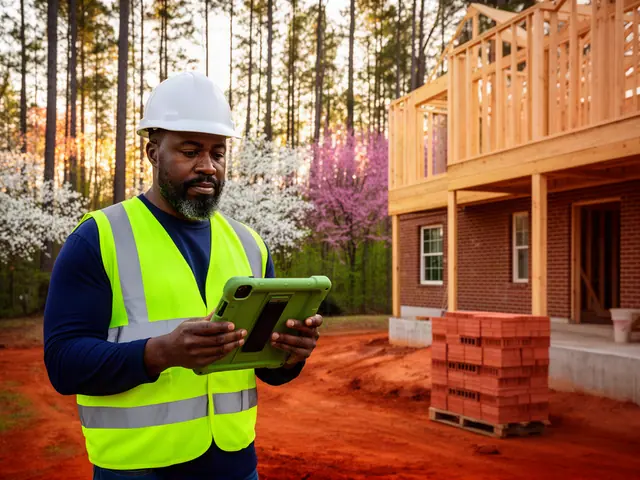
Slateshire Finance, which arranges business funding for builders in Sanford, NC and Lee County, explains what people mean by a contractor's loan: working capital for a job, a revolving line, equipment financing, or a construction loan on a specific property. The post shows how a small residential builder can tell which one fits, and what partners check first.
One phrase, four different things
- Working capital for a job. A lump sum that carries payroll and materials until the draw arrives.
- A contractor line of credit. A revolving limit for the gaps that repeat job after job.
- Equipment financing. A loan or lease on a skid steer, trailer or truck, secured by the machine.
- A construction loan on a property. Funding for building a specific house or building, released in draws, usually arranged by the property's owner.
The first three are business funding for the contractor's company. The fourth usually belongs to whoever owns the land, which may or may not be you.
Who is building in Lee County, NC
County Business Patterns counted 46 residential building contractors with employees in Lee County, NC in 2023, and 38 of them had fewer than five employees. Separately, Nonemployer Statistics found 167 residential builders with no payroll in 2024, a different program.
So 38 of the 46 residential builders with employees had fewer than five of them. That shapes which kind of contractor's loan makes sense.
How to tell which one you need
| If your question is... | You are probably looking for |
|---|---|
| How do I make payroll until the draw comes? | Working capital |
| Why am I short at the start of every job? | A line of credit |
| How do I pay for this machine? | Equipment financing |
| How do I fund building a spec house? | A construction loan on the property |
A small builder may use the first three at different times. The contractors and builders page goes through draws and retainage in more detail.
When a line of credit fits better than a loan per job
Taking a new short loan for every job is one way to fund each gap. If the gap shows up every time a job starts, a business line of credit can fit better: draw at the start, repay from the draw, and draw again on the next job, without a new application each time.
Partners may ask how steady your work has been, because a line commits them to future draws.
Spec houses and the construction-loan question
A builder putting up a spec house on land the company owns is in a different position from one working for a homeowner. Financing the house itself is a property loan, usually with the land as collateral and funds released as the house goes up. That is typically arranged with banks and construction lenders who specialize in it, and it sits outside the business funding structures on this site.
What this site can help with is the company side: the payroll, equipment and timing gaps around those projects.
What partners check first on a contractor's request
- Bank statements showing how money moves through the business
- Current contracts and their payment schedules
- License details, which a partner may verify
- Existing loans, equipment financing and advances
A license check can catch a name mismatch the owner did not expect. The NC general contractor license guide explains what partners look for; county figures are on the Sanford, NC page.